
'The government is using the Intelligence Bureau to go after NGOs.' 'It is not only the NDA, the UPA also didn't like NGOs.' 'NGOs predominantly work with the poor. So, when you cancel an NGO, the affected are the poor, the Dalits, the tribals, the street children and the marginalised.'

Domestic and foreign companies pour in a slew of investments in Gujarat.

Kavanaugh told the audience that all his new law clerks at the Supreme Court were women -- a first in the history of the Supreme Court.

One should appreciate the sagacity and audacity of JRD and Nani Palkhivala in founding TCS on April 1, 1968. At that time there was no Microsoft or Intel, SAP or Accenture, much less Google.
They needed a person who could build and execute their vision: A frontiersman; a problem solver and an institution builder. It was their and India's good fortune that Faqir Chand Kohli more than measured up to their requirements and indeed laid the foundation to take TCS to unimaginable heights and to the giant success that it is today. Shivanand Kanavi salutes the incomparable F C Kohli, who passed into the ages last week.

He expressed hope that it will also benefit a large number of Hindi-speaking umpires and those giving training in this field, to whom the rules in English are hard to understand.

Sri Lanka captain Angelo Mathews said an inspirational net session with the legendary Kumar Sangakkara played a key role.
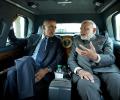
Obama said he has just two years left in office.

Star batsman Kevin Pietersen says he has no issues playing under England Test captain Alastair Cook and coach Peter Moores as he prepares for a national recall by resuming county cricket at Surrey.

Sadly, for hundreds of millions in India, that inequality from their birth and the utterly inadequate schooling and health care they receive thereafter mean that the lottery is stacked against them.

Mahesh Rangarajan, director of the historic Nehru Memorial Museum and Library in New Delhi, tells Sheela Bhatt how the first prime minister will always remain relevant, and the efforts being made to keep his legacy alive.

50 years ago, on April 1, 1968, Tata Consultancy Services -- now India's leading IT company -- was born. The foundation for TCS was laid by Faqir Chand Kohli whose life touched directly or indirectly many, many, Indians, says Shivanand Kanavi.

On Reva, Mahindra says electric cars are an innovation that can disrupt the automobile sector.

Prime Minister Narendra Modi's three-day visit to Britain has seen India and the UK agreeing on Rs 90,000 crore deals.

'When I was younger, 15 years or 20 years seemed like a really long time. But, as you journey though life, you don't realise where the years disappear...'

'Modi is a master of convergence. By his ability to converge and add new features to a non-star idea, he is able to sell it. Like how he has turned Kutch into a tourist destination by selling the salt desert of the Rann as a flat snow desert of the night and roping in Amitabh Bachchan to sell it. In one stroke this has ensured economic returns to the people and on the other hand it has taken care of the national security angle in the sense that the border population in the Rann, which is almost entirely Muslim, is feeling better as now they are much more connected with the mainstream.' Ahead of the launch of his book on the much-debated Modi model of governance, journalist Uday Mahurkar speaks to Rediff.com's Sheela Bhatt.

Read the full transcript of President Obama's State of the Union address on Wednesday at the US Capitol in Washington.
